

Grand pianos deliver superior action, greater resonance, and a wider dynamic range than upright pianos. Uprights fit more homes and more budgets. Which works for you comes down to available space, your budget, and how serious your playing is.
In a grand piano, strings run horizontally, which allows for longer string length and a larger soundboard. Both factors produce greater resonance and a richer, more complex tone. In an upright piano, strings run vertically to keep the instrument compact, limiting string length and soundboard size. The result is a brighter, less resonant sound — though a quality upright like the Yamaha U or YUS Series closes that gap substantially. Grand pianos also project sound upward from an open lid; uprights project sound from the back, where the instrument is placed against a wall.

This is the most significant difference for pianists. In a grand piano, hammers return to rest position by gravity after striking the strings, and a double escapement mechanism allows rapid key repetition without the key fully resetting. In an upright, hammers return via spring tension rather than gravity, which limits repetition speed. For fast passages and fine dynamic control, grand action is more expressive and gives players more control over tone.
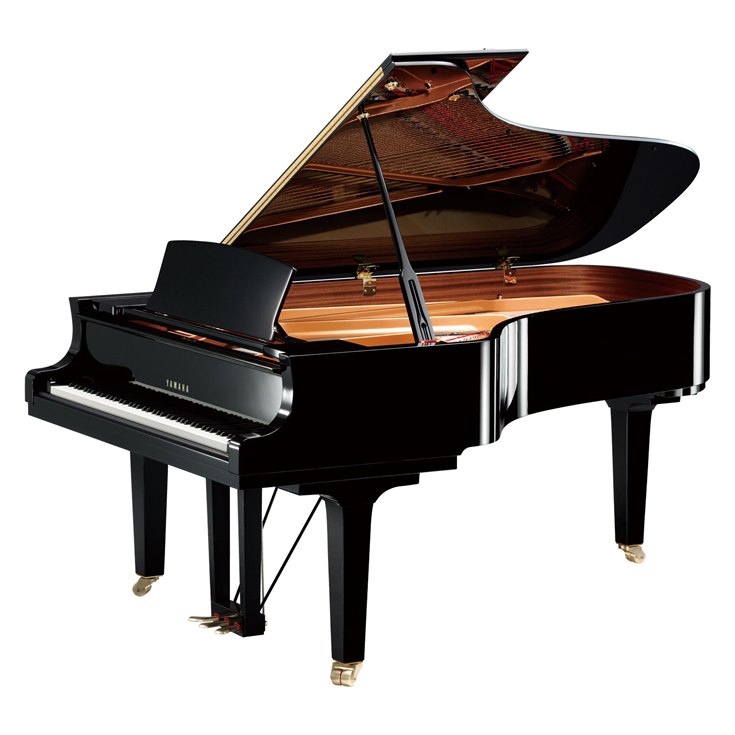
Grand pianos have three pedals: the right damper (sustain) pedal lifts all dampers so strings ring freely; the middle sostenuto pedal sustains only notes held at the moment it’s pressed; and the left una corda pedal shifts the entire action so hammers strike fewer strings per note, softening the tone.
Most uprights also have three pedals, but the middle one is a practice pedal, sometimes called a muffler pedal, that drops a felt strip between the hammers and strings to drastically reduce volume. It is useful for late-night playing but is not the same as a sostenuto. The left soft pedal on an upright moves the hammers physically closer to the strings rather than shifting the action sideways, which is how una corda works on a grand.
Concert grands reach 9 feet or more in length. Baby grands start at around 5 feet, making them viable for a larger living room or a dedicated music room. Browse our Yamaha baby grand pianos to see the models currently on our Lawrenceville showroom floor.
Uprights stand against a wall and take a fraction of the floor space. Our Yamaha upright pianos range from the entry-level b Series to the professional U and YUS Series, which are used in conservatories worldwide.
If space and budget allow, a grand piano rewards your playing with a more expressive, responsive instrument. If you’re working with limited space, a quality upright, digital piano, or hybrid TransAcoustic model gives you a serious instrument without requiring a dedicated room. Most piano teachers recommend starting on a quality upright and upgrading to a grand when the time and space are right.
Not always. A grand piano has a superior action and greater resonance, but a professional-quality upright like the Yamaha U1 or YUS Series is a more capable instrument than an entry-level baby grand. The quality of construction matters as much as the type.
Grand pianos have a damper pedal on the right, a sostenuto pedal in the middle, and a una corda (soft) pedal on the left. Most uprights replace the sostenuto with a practice or muffler pedal that reduces volume for quiet-hours playing. The left soft pedal on an upright moves the hammers closer to the strings, rather than shifting the entire action sideways as the una corda does on a grand.
A baby grand starts at around 5 feet in length and requires clearance on all sides to open the lid and seat a pianist comfortably. Measure your room carefully before purchasing, and factor in bench depth and walking clearance.
A quality digital piano or hybrid instrument like Yamaha’s TransAcoustic models offers weighted keys, headphone capability, and realistic tone in a compact footprint. For players in apartments or shared spaces, they are a practical and musically serious option.
If you have questions or want to sit down and try a few models in person, we’re open 7 days a week in Lawrenceville — no appointment needed.