

A grand piano is an acoustic piano built with its strings, soundboard, and metal frame laid out horizontally, the case extending back from the keys rather than rising up behind them. That horizontal design is the whole point. It gives the grand its longer strings, its larger soundboards, and the deep, powerful sound that has defined the instrument in concert halls and private homes for more than three centuries.
If you are weighing a grand against an upright piano or one of the modern digital pianos, this guide explains exactly what sets a grand apart, how it produces sound, the range of sizes from a baby grand up to a full concert grand, and what each of the pedals actually does.

A grand piano is a horizontal acoustic piano. Press a key, and you set the piano action in motion: a felt-tipped hammer swings up and strikes a set of strings inside the case. Those strings vibrate, the vibration passes through the bridge into the soundboard, and the soundboard amplifies it into the tone you hear. Release the key, and the hammer returns to its rest position while a damper drops back onto the strings to stop them ringing.
This is the same basic mechanism found in every acoustic piano, including the upright. What changes in a grand is the geometry. The strings and soundboard sit flat, the longer strings of the bass and tenor have room to run their full length, and the larger soundboards have more area to move air. The result is greater resonance, a wider dynamic range, and a more powerful sound than a vertical instrument of the same quality can produce.
Three components work together to produce sound: the action, the strings, and the soundboard. The action translates your fingers on the keys into motion. The hammers strike the strings, which carry the pitch. The strings and soundboard then convert that energy into an audible tone. A cast-iron metal frame, also called the plate, anchors the whole assembly and holds the immense tension of the strings inside, often several tons across the full set.
Because a grand’s action uses gravity to reset each hammer to its rest position, the keys repeat faster and respond with more control than a vertical action that relies on springs. For the pianist, that means cleaner fast passages and finer command over volume, from the softest pianissimo to a fully loud fortissimo. It is the responsiveness, as much as the size, that makes the sound of a grand the standard for classical music and the concert stage.
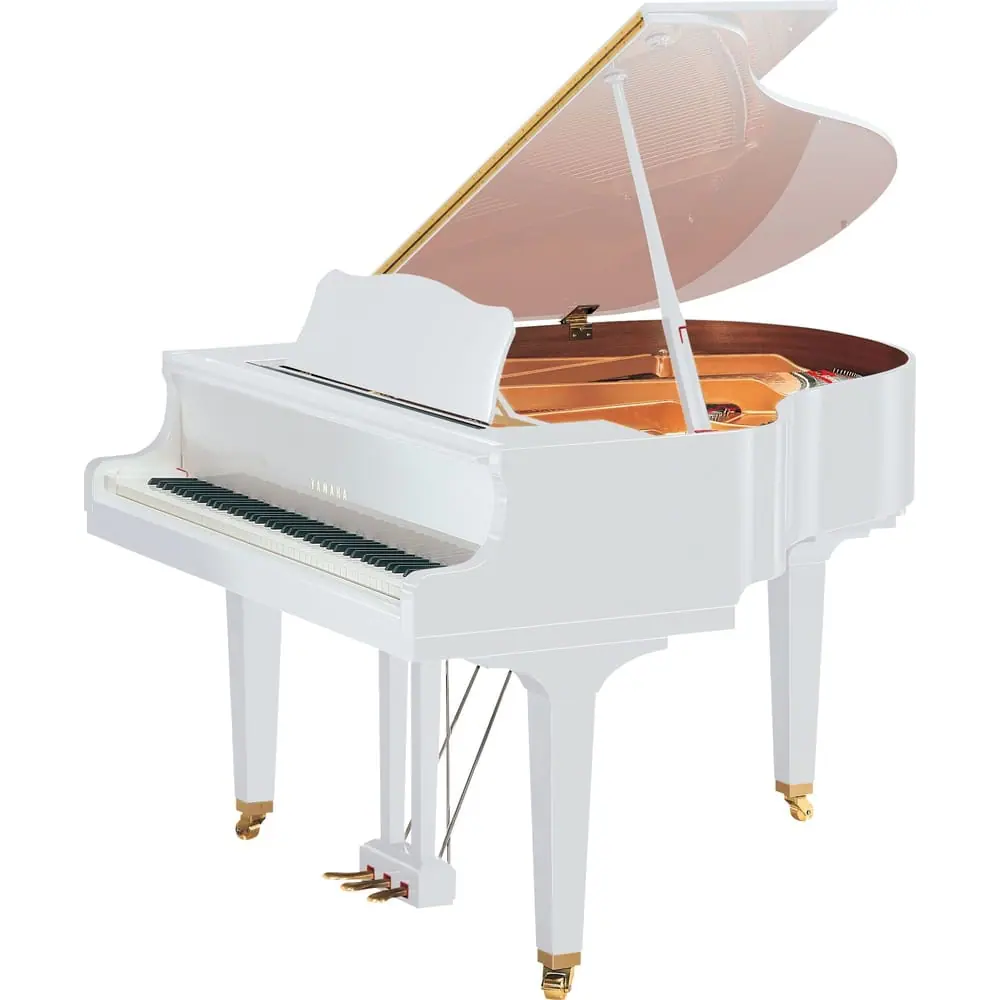
Grand pianos range widely in size, and size is the single biggest factor in how one sounds. A longer case means longer strings and larger soundboards, which generally means more volume, more resonance, and a richer low end. A smaller size takes up less space, which is why the category spans everything from a compact instrument for an apartment to a nine-foot concert grand.
A baby grand and a concert grand are both grand pianos, but the difference in scale is large. The bigger instrument is built for performances in concert halls; the smaller one is built to bring that same voice into a living room.
Most grand pianos have three pedals, and each shapes the sound in a different way.
On an upright, the middle pedal is often a practice pedal instead, dropping a strip of felt between the hammers and strings and greatly muting the sound so you can play quietly at home. True sostenuto is one of the features that separates a grand piano from a vertical piano.
An upright piano, sometimes called a vertical piano, runs its strings and soundboard vertically so the case sits flat against a wall. That makes vertical pianos the right choice when space is tight. The trade-off is a shorter string length and a smaller soundboard, plus a spring-assisted action that repeats slightly slower than a grand’s.
Digital pianos take a different path. Instead of strings inside a wooden case, most digital pianos recreate the recorded sound of an acoustic piano and produce sound through speakers or headphones. They win on volume control, price, and footprint. What they cannot fully match is the sound quality, touch, and physical resonance of a real acoustic instrument, which is why players who have the room tend to return to a grand. We cover this trade-off in detail in our guide to choosing between a digital piano and an acoustic piano.
The first pianos appeared in the early 1700s, and the musical instrument has been refined by piano manufacturers ever since. Today, Yamaha pianos are among the most played and most recorded grands in the world, and we stock the full range in our showroom.
Show Image
Our Baby & Grand Piano collection runs from the compact GB1K through the GC and CX series, the premium SX series, and the flagship CF concert grands. We also carry pre-owned grands from Steinway & Sons, Kawai, and other makers in our used piano store, so you can compare different makes and styles side by side. Every acoustic grand we sell can be fitted for in-home piano tuning to keep it sounding its best.
First-time buyers looking at a classic grand for the living room and seasoned pianists shopping a concert instrument are equally welcome to play any piano on the floor before deciding.
Both are grand pianos with the same horizontal design. The difference is size. A baby grand piano is generally around five feet long, while a full-size grand or concert grand can reach nine feet. The larger size gives longer strings and larger soundboards, which produce more volume and resonance, while the baby grand fits more easily into private homes.
The smallest grands are compact baby grands of roughly five feet. Yamaha’s GB1K is its most compact and affordable grand, designed for rooms where space is limited while still delivering a full, resonant tone comparable to many larger models.
A grand piano lays its strings and soundboard horizontally; an upright piano stands them vertically to save space. The grand’s longer strings, larger soundboard, and gravity-based action give it a more powerful sound, a wider dynamic range, and faster key repetition.
For tone, touch, and resonance, an acoustic grand is generally regarded as superior because it produces sound from real strings and a wooden soundboard. Digital pianos offer advantages in price, volume control, and a smaller footprint, which can make them the practical choice for some rooms.
A baby grand needs a footprint of roughly five feet deep by five feet wide, plus room for the bench and the player. Larger grand pianos extend up to nine feet deep, so the room and the instrument should be matched carefully before you buy.
Come play our selection of new and pre-owned grand pianos in person. Send us a message or call (609) 403-6045, and we will help you find the right instrument for your room, your budget, and your music.