Comparison Chart
Roland LX-5 vs LX-6 vs LX-9 Comparison Chart
Three upright digital pianos on the same Piano Reality Modeling engine. The keyboard, the speakers and the cabinet are what change.


Roland’s LX series is three upright digital pianos built on the same Piano Reality Modeling sound engine. This chart puts the LX-5, LX-6 and LX-9 side by side, so you can see where they differ: the keyboard action, the speaker system and the cabinet. All three are on display at Pianos of Princeton in Lawrenceville.
The Differences in Brief
- LX-5: the PHA-50 keyboard with escapement, a four-speaker system (90 W) and the most compact cabinet.
- LX-6: Roland’s Hybrid Grand Keyboard with grand-length keys, and five speakers built around a 9-7/8″ cabinet speaker (116 W).
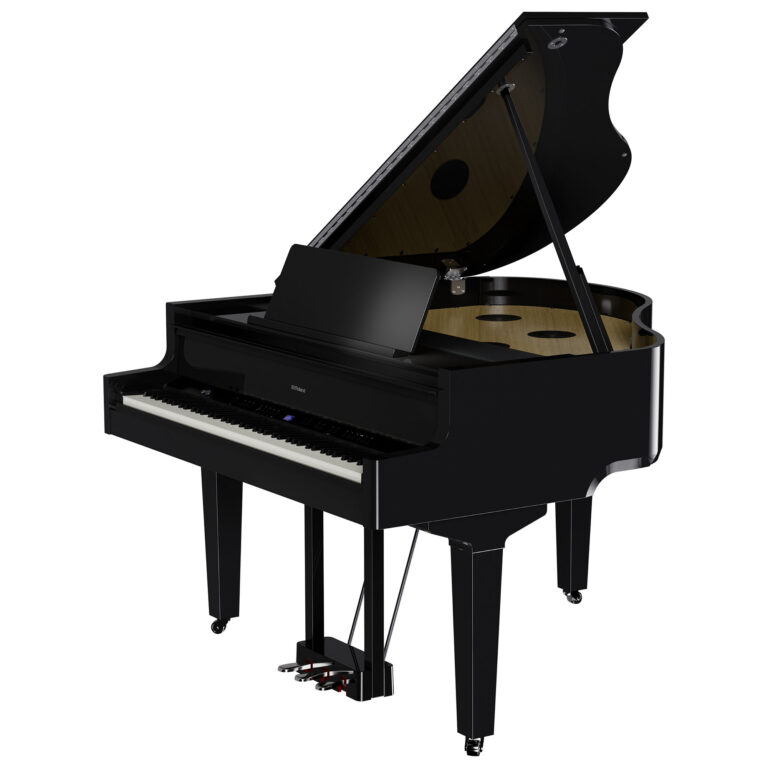
- LX-9: the Hybrid Grand Keyboard with Haptic Key Vibration, eight speakers (162 W), the Responsive Damper Action pedal, and a lid that opens like an acoustic piano’s.
Roland LX-5 vs LX-6 vs LX-9 Specifications
| Specification | |
|
|
|---|---|---|---|
| Keyboard | |||
| Action | PHA-50 keyboard: 88 keys, hammer action, escapement, Ebony/Ivory Feel, wood and molded materials | Hybrid Grand Keyboard: 88 keys, progressive hammer action, escapement, Ebony/Ivory Feel, grand-length keys of wood and molded materials | Hybrid Grand Keyboard: 88 keys, progressive hammer action, escapement, Ebony/Ivory Feel, grand-length keys of wood and molded materials, Haptic Key Vibration |
| Touch sensitivity | Key Touch: 100 steps; Hammer Response: off or 10 steps | Key Touch: 100 steps; Hammer Response: off or 10 steps | Key Touch: 100 steps; Hammer Response: off or 10 steps |
| Sound | |||
| Sound engine | Piano Reality Modeling, 324 tones | Piano Reality Modeling, 324 tones | Piano Reality Modeling, 324 tones |
| Max. polyphony | Piano tones: unlimited; other tones: 256 | Piano tones: unlimited; other tones: 256 | Piano tones: unlimited; other tones: 256 |
| Ambience | Studio, Lounge, Concert Hall, Cathedral (11 depth steps) | Studio, Lounge, Concert Hall, Cathedral (11 depth steps) | Studio, Lounge, Concert Hall, Wooden Hall, Stone Hall, Cathedral (11 depth steps) |
| Headphones | Piano Reality Headphones Ambience | Piano Reality Headphones Ambience | Piano Reality Headphones Ambience |
| Speakers | |||
| Speakers | 4: two cabinet speakers (5″) each with a 1″ spatial tweeter, two 3-3/16″ near-field speakers | 5: a 9-7/8″ cabinet speaker in its own speaker box, two 4-3/4″ × 3-3/16″ near-field speakers, two 1″ dome spatial speakers | 8: two 9-7/8″ cabinet speakers, two 4-3/4″ × 3-3/16″ near-field speakers, two 3-3/16″ center near-field speakers, two 1″ dome spatial speakers |
| Total power | 90 W | 116 W | 162 W |
| Pedals | |||
| Pedals | Damper (Progressive Damper Action), soft, sostenuto | Damper (Progressive Damper Action), soft, sostenuto | Damper (Responsive Damper Action), soft, sostenuto (can work as a muffler pedal) |
| Display | |||
| Display | Graphic LCD, 128 × 64 dots | Graphic LCD, 128 × 64 dots | Graphic LCD, 128 × 64 dots |
| Connections | |||
| Bluetooth | Bluetooth 5.0: audio, MIDI (Bluetooth Low Energy) | Bluetooth 5.0: audio, MIDI (Bluetooth Low Energy) | Bluetooth 5.0: audio, MIDI (Bluetooth Low Energy) |
| Ports | USB Type B computer port (MIDI and audio), USB Type A memory port, input jack, line outputs (L/Mono, R), 2 headphone jacks | USB Type B computer port (MIDI and audio), USB Type A memory port, input jack, line outputs (L/Mono, R), 2 headphone jacks | USB Type B computer port (MIDI and audio), USB Type A memory port, input jack, line outputs (L/Mono, R), 2 headphone jacks |
| Features | |||
| Internal songs | 394, including lesson books (scales, Hanon, Beyer, Burgmuller, Czerny 100) | 394, including lesson books (scales, Hanon, Beyer, Burgmuller, Czerny 100) | 394, including lesson books (scales, Hanon, Beyer, Burgmuller, Czerny 100) |
| Recorder | Standard MIDI Files (100 songs, 3 parts); audio files (WAV) to a USB flash drive (up to 80 minutes per song) | Standard MIDI Files (100 songs, 3 parts); audio files (WAV) to a USB flash drive (up to 80 minutes per song) | Standard MIDI Files (100 songs, 3 parts); audio files (WAV) to a USB flash drive (up to 80 minutes per song) |
| Metronome | Adjustable tempo, beat, and volume, with 80 rhythm patterns | Adjustable tempo, beat, and volume, with 80 rhythm patterns | Adjustable tempo, beat, and volume, with 80 rhythm patterns |
| Practice functions | Twin Piano, Dual, Split, Transpose | Twin Piano, Dual, Split, Transpose | Twin Piano, Dual, Split, Transpose |
| Temperaments | 10, with selectable key | 10, with selectable key | 10, with selectable key |
| Master tuning | 415.3 to 466.2 Hz | 415.3 to 466.2 Hz | 415.3 to 466.2 Hz |
| Cabinet | |||
| Dimensions | 54-1/2″ W × 18-7/16″ D × 40-15/16″ H | 54-1/2″ W × 19-7/16″ D × 44-1/16″ H | 54-15/16″ W × 19-3/8″ D × 46-7/16″ H (lid closed); 49-3/8″ high with the lid open |
| Weight | 164 lbs (Polished Ebony: 167 lbs) | 192 lbs (Polished Ebony: 196 lbs) | 242 lbs (Polished Ebony and Polished White: 245 lbs) |
| Key cover | Sliding | Sliding | Fallboard |
| Finishes | Polished Ebony, Charcoal Black, Dark Rosewood, Light Oak | Polished Ebony, Charcoal Black, Dark Rosewood | Polished Ebony, Polished White, Charcoal Black |
| Power consumption | 31 W | 28 W | 65 W |
Specifications from Roland.
Which Is Right for You?
The quickest way to choose is to play all three. Sit at each one, play the same piece, then try it through headphones. Most players feel the step from the LX-5 to the LX-6 in the keyboard first; the LX-9’s difference is the sound in the room, with the lid open.
Visit us at 2901 US-1, Lawrence Township, NJ 08648, or call (609) 403-6045.
More Comparison Charts


Yamaha Pianos Comparison ChartsRoland Pianos Comparison ChartsYamaha vs Roland Comparison Charts